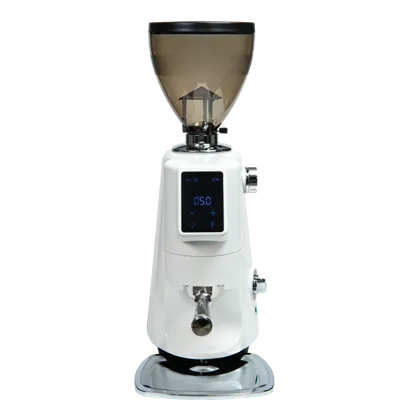
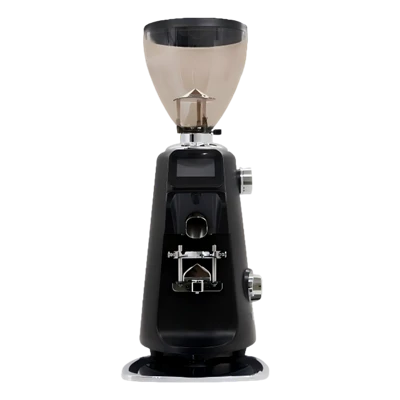
First of all, there is a difference between the grinder for single products and the Italian grinder. Before we start, we need to confirm whether your grinder is suitable for making Italian coffee. The scale of the single product mill is adjusted in a wide range, and the particles are generally coarse, which can not be fine tuned and can not meet the needs of making espresso.
In addition, when you get a newly purchased coffee bean and plan to blend it, you can learn the recommended extraction data from the seller first. Please make sure that the inside of your bean grinder is clean before starting the adjustment and calibration. It is better to remove the cutter head and clean it with a brush or air blow. Try to clean up the residual coffee powder in the bean grinder.
Grinding process
Because of the need of our work, we often help coffee bean buyers to introduce how to correct the extraction. Here is a common grinding method used by our coffee baking factory:
The first step is to adjust the dial of bean grinder to infinitesimal size (considering the wear of cutter heads in different stores, we are used to adjust the grinding in an extreme way first). Then, clear the weight of the coffee machine handle on the electronic scale, put the coffee machine handle on the electronic scale after receiving the powder, and weigh the weight on the electronic scale. The target is to weigh 18G of powder, cloth the powder, and use our usual pressure powder (or use a constant powder compressor).
After preheating the cooking head, carry out the extraction of Italian concentration.
Of course, the first drop of coffee is still not left within 8 seconds of extraction, so stop extraction decisively and proceed to the next step: adjust the scale to a large scale (the grinder of general brand in the market will have a scale with digital description, for example, the grinding degree we used before is 1 scale, then try 2 scales). Then we weigh 18G of powder and try to extract the concentrated solution. If the obvious over extraction still exists, we will stop extraction decisively, adjust the scale to 1 grid, and then try to extract.
Repeat the steps of scale adjustment and extraction until the scale is adjusted to the concentration liquid can flow out normally. Of course, if you are a glutton, you can get the required target scale quickly through the comprehensive judgment of baking degree and particle sense.
In the third step, we start to test the extraction rate and taste the concentrated liquid. When the concentrate flows out normally, we prepare a coffee cup and use it to weigh the coffee after the weight is cleared on the electronic scale. Because we use 18G powder, according to the extraction standard of espresso, generally speaking, the ratio of powder to water is controlled within the range of 1:2-1:2.5 (the ratio of powder to water, that is, the ratio of powder weight to extraction liquid weight. If we weigh 18G powder, the extraction weight of the target is between 36g-45g)
In the fourth step, after the flow rate of coffee liquid begins to be normal, it starts to correct the taste. In the extraction time of 20s-25s, can we keep the extraction state within the range of 18G powder and 36g-45g concentrated liquid.
If the concentrated taste has strong scorch, bitterness, paste, astringency and miscellaneous feeling, it is excessive extraction. At this time, it is necessary to fine tune the scale of the grinding plate, adjust the scale to 0.5 grid, and then test.
If you see that the flow rate of the coffee liquid is a little flying during the extraction, you may still get a cup of espresso with the weight between 36g and 45g in 25s, but the taste is slightly sour and the body is light. Considering that this cup of coffee should be insufficient in extraction, then adjust the dial to 0.25 grid. Carry out the extraction test of the concentrated solution again, and use the stopwatch to time.
Yes, this idea sounds tedious. In fact, it is to fine tune the grinding degree by controlling the amount of powder and the extraction weight of the target. First, lock the large area, then fine tune the small area to find the most appropriate grinding degree.
After repeating the above steps once or twice, you can get close to the target scale.
Step 6: up to now, if the flow rate of concentrate extraction is stable and the oil color is normal, it will probably reach the standard value. However, if the flow rate is still a little fast / slow, the conditional grinder can fine tune the 0.1 scale. If, unfortunately, you find that the required grinding degree is exactly between the two scales, but the grinder has no intermediate scale to choose from, then you can consider adjusting the grinding force correction.
After the adjustment of the grinder, if you think the flavor of the extracted espresso is still lacking, you need to find other reasons. For example, ask your bean supplier if they have more accurate suggestions for extracting water temperature, or if ristretto is more suitable for this bean
Using this method to adjust grinding, you can complete the task in less than 200g beans, which seems complicated. But because every adjustment has rules to follow, rather than luck, it is more convenient, labor-saving and cost saving. Try it.