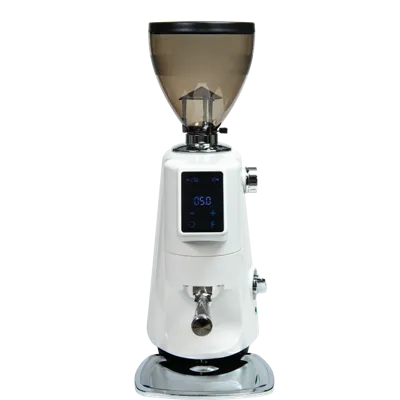
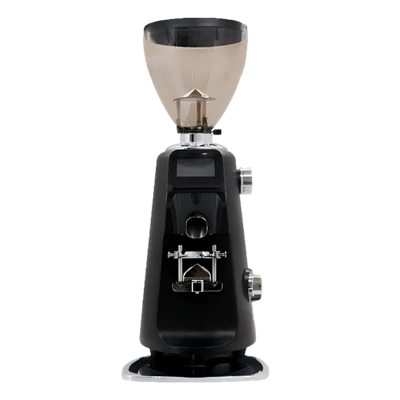
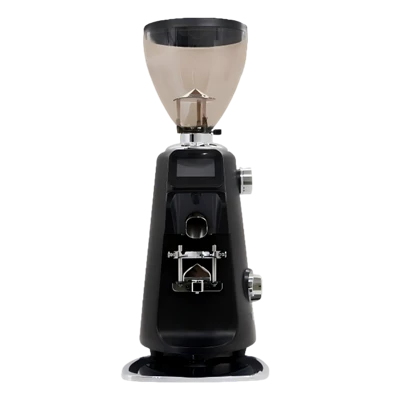
Choosing a commercial coffee grinder is not simply a matter of finding a machine with a large burr or a powerful motor. For cafés, restaurants, coffee equipment distributors, wholesalers, and private-label brands, the right grinder needs to match the actual workload, workflow, counter space, dosing requirements, and purchasing plan.
A grinder that is too small can become a bottleneck during busy periods. A grinder that is significantly larger than necessary can increase equipment cost and occupy valuable counter space without providing a practical benefit.
For businesses sourcing commercial coffee grinders, the most useful starting point is to look at how the grinder will be used, then compare burr size, grinding capacity, motor configuration, hopper, dosing method, and available customization.
Start With Your Daily Coffee Volume
Daily workload is one of the clearest ways to narrow down the right commercial grinder.
A small café with moderate espresso demand does not necessarily need the same grinder as a busy coffee shop, restaurant, hotel, or commercial coffee program.
Instead of asking only:
How powerful is the grinder?
Start with:
How much coffee will this grinder actually need to process?
Consider:
1.Average drinks served per day
2.Peak-hour demand
3.Espresso dose per drink
4.Number of operating hours
5.Whether the grinder will be used continuously
Whether one grinder serves one coffee or several coffee beans
For example, a grinder producing 7–12 kg/h may be appropriate for a different workload than a model rated at 15–30 kg/h. The actual requirement depends on how the equipment is used rather than the maximum specification alone.
Match the Grinder to Your Commercial Application
Different businesses have different requirements.
Espresso-focused cafés generally need a grinder that provides consistent particle size, convenient adjustment, and repeatable dosing during service.
A compact commercial grinder can be suitable when the daily workload is moderate and counter space is limited.
Restaurants and hotels may have less concentrated espresso demand but longer operating hours. The grinder should therefore be evaluated for durability, workflow, hopper capacity, and ease of operation.
For distributors, the decision is broader than choosing one grinder.
You may need several models covering different price points, burr sizes, capacities, and operating configurations.
A supplier with multiple commercial grinder configurations can make it easier to build a product range without sourcing every model from a different factory.
Private-label buyers have additional requirements such as:
- Brand logo
- Housing color
- Packaging
- Product labeling
- Voltage configuration
- Selected product specifications
- User manuals and documentation
- In this case, the supplier's OEM capability becomes part of the product selection process.
Choose the Right Burr Size
Burr diameter is one of the most visible specifications when comparing commercial coffee grinders, but bigger does not automatically mean better.
The burr needs to match the expected workload and grinder configuration.
JieHui's commercial grinder range includes 64mm, 74mm, and 83mm flat burr configurations, providing several options for different commercial applications.
A 64mm grinder can be a practical choice when you need commercial capability without moving to a larger machine.
It can make sense when:
- Daily grinding volume is moderate
- Counter space is limited
- A smaller hopper is acceptable
- The grinder is mainly used for espresso
- You want a lower equipment footprint
JieHui's listed 64mm models include configurations around 7–12 kg/h, depending on the model.
A 74mm grinder sits between compact commercial models and larger high-output configurations.
It can be considered when the business needs more grinding capacity while still keeping the grinder within a practical commercial footprint.
JieHui lists 74mm models with grinding capacities around 9–19 kg/h or 10–19 kg/h depending on the configuration.
An 83mm grinder is more relevant when grinding volume and operating speed become more important.
JieHui's listed 83mm models are rated at 15–30 kg/h and use 1.2kg hoppers. Some configurations also include timer and weighing functions.
For buyers comparing commercial grinders, the key point is not to choose the largest burr available. Choose the burr size that matches the workload you actually expect.
 JX-680MINI Commercial Coffee Grinder
- Grinding Capacity: 7–12 kg/h
- Burr Lifetime: 500 kg
- Motor: 350W / 1400 RPM
- Dosing: Time Mode
- Voltage: 110–240V, 50/60Hz
 JX-683P Commercial Coffee Grinder
- Grinding Capacity: 15–30 kg/h
- Burr Lifetime: 1,000 kg
- Motor: 550W / 1400 RPM
- Dosing: Time Mode & Weighing Mode
- Voltage: 110–240V, 50/60Hz
- Heat Dissipation: Fan Cooling
- Bean Hopper Capacity: 1.2 kg
 JX-683 Commercial Coffee Grinder
- Grinding Capacity: 15–30 kg/h
- Burr Lifetime: 1,000 kg
- Motor: 550W / 1400 RPM
- Voltage: 110–240V, 50/60Hz
- Bean Hopper Capacity: 1.2 kg
 JX-680P Commercial Coffee Grinder
 JX-680 Commercial Coffee Grinder
- Grinding Capacity: 10–19 kg/h
- Burr Lifetime: 750 kg
- Motor: 450W / 1400 RPM
- Voltage: 110–240V, 50/60Hz
- Bean Hopper Capacity: 1.2 kg
 JX-928 Commercial Coffee Grinder
- Grinding Capacity: 10–19 kg/h
- Burr Lifetime: 750 kg
- Motor: 600W / 600–1400 RPM Variable Speed
- Voltage: 110–240V, 50/60Hz
- Bean Hopper Capacity: 120g
- Heat Dissipation: Fan Cooling
Don't Choose a Grinder by Wattage Alone
Motor power is important, but wattage does not tell you everything about commercial performance.
Two grinders with similar motor ratings can have different burr diameters, RPM, cooling systems, grinding capacities, and mechanical designs.
When comparing commercial coffee grinders, check:
| Specification | Why It Matters |
|---|---|
| Motor power | Indicates the motor's rated electrical input |
| RPM | Affects grinding speed and operating characteristics |
| Burr diameter | Influences grinding capacity and grinder design |
| Grinding capacity | Helps match the grinder to workload |
| Cooling | Relevant during repeated grinding |
| Duty cycle | Important for sustained commercial use |
For example, JieHui's JX-683P uses an 83mm flat burr, a 550W motor at 1400 RPM, a 1.2kg hopper, and motor fan cooling, with a listed grinding capacity of 15–30 kg/h.
This illustrates why motor power should be evaluated together with the rest of the grinder specification.
Hopper Capacity Should Match Your Workflow
A larger hopper can reduce the need for frequent refilling, but it is not automatically the right choice.
Think about your actual workflow.
Useful when:
- Coffee beans change frequently
- Daily volume is moderate
- Counter height is limited
- Several different coffees need to be used
- The same coffee is ground continuously
- Daily volume is high
- Frequent refilling would slow down service
The grinder is used in a high-volume commercial environment
JieHui's commercial models include hopper configurations ranging from approximately 0.5kg to 1.5kg depending on the model.
The best hopper size is therefore related to turnover, not simply the largest capacity available.
Decide How You Want to Control Dosing
Dosing affects both workflow and consistency.
A basic grinder may rely on manual operation, while commercial models can use timers or weighing functions.
A timer allows the grinder to run for a preset period.
This can make repeated dosing easier because staff do not need to manually estimate grinding time for every dose.
A weighing function provides another level of control by using a target weight as part of the dosing process.
For distributors and coffee equipment brands, this can also be an important product differentiator when selecting models for different market segments.
JieHui's JX-683P is listed with timer and weighing control, while other models use different control configurations.
Think About Counter Space Before Ordering
Commercial grinders can take up significant vertical and horizontal space.
Before selecting a model, measure:
- Counter width
- Available depth
- Total machine height
- Clearance above the hopper
- Space required for cleaning
- Distance from the espresso machine
- Space needed for staff movement
For example, JieHui's 83mm JX-683P is listed at 40 * 25 * 66.5 cm, while the 74mm JX-680P is listed at 41 * 25 * 63.5 cm.
The difference may look small on paper, but it can matter when several pieces of equipment are installed on the same counter.
Commercial Coffee Grinder vs. Home Coffee Grinder
A commercial grinder should be evaluated according to its working environment.
| Factor | Commercial Grinder | Home Grinder |
|---|---|---|
| Intended workload | Higher | Lower |
| Motor configuration | Built around repeated use | Usually designed for intermittent use |
| Burr size | Often larger | Generally smaller |
| Hopper | Often larger | Usually smaller |
| Dosing | Timer, weighing or commercial dosing options | Simpler controls are common |
| Construction | Designed around commercial operation | Designed around home use |
| Maintenance | Regular service expected | Lower-frequency use |
A home grinder may be perfectly suitable for personal coffee preparation, but it should not automatically be treated as a substitute for commercial equipment.
If a grinder will be operating throughout a busy service period, its workload and operating design should be considered before purchase.
What Features Actually Matter for Your Business?
Not every commercial grinder needs every available feature.
A useful way to compare models is to divide specifications into must-have, useful, and unnecessary.
These depend on your operation:
- Correct voltage
- Suitable burr size
- Sufficient grinding capacity
- Appropriate dosing method
- Suitable counter dimensions
Depending on the business:
- Timer
- Weighing
- Fan cooling
- Larger hopper
- Multiple configuration options
Additional functions can increase product complexity without providing a practical benefit for every application.
The goal should be to match the grinder with the work rather than purchase the longest specification sheet.
Why OEM Matters for Commercial Coffee Grinder Buyers
OEM purchasing allows a buyer to sell an existing grinder model under its own brand with agreed customization.
For a coffee equipment distributor or private-label brand, this can include:
- Logo application
- Housing color
- Packaging
- Labeling
- Voltage
- Selected product configuration
JieHui's commercial grinder range supports private-label and OEM requirements, including logo, color, packaging, product configuration, and voltage options from 110–240V, 50/60Hz.
For OEM buyers, always confirm which specifications are customizable before placing the order. Not every component of an existing grinder platform needs to be modified, and unnecessary changes can increase development time and cost.
JieHui Commercial Coffee Grinders for Different Business Needs
JieHui Coffee is a China-based coffee grinder manufacturer specializing in commercial, automatic, and single-dose grinders. Its commercial range covers 64mm, 74mm, and 83mm flat burr configurations, allowing buyers to compare different capacity and equipment-size options within one product range.
For a more compact commercial setup, the 64mm Commercial Coffee Grinder range includes models rated around 7–12 kg/h. The 74mm range moves into approximately 9–19 kg/h, while the 83mm models are listed around 15–30 kg/h.
For buyers comparing specific commercial configurations, the Commercial Burr Grinder range provides a broader view of the commercial lineup, while the 83mm Coffee Grinder range is relevant when higher grinding capacity is a priority.
JieHui also provides OEM support for distributors, coffee equipment brands, and private-label buyers, with customization available around approved product configurations, branding, color, packaging, and voltage requirements.
A Simple Commercial Coffee Grinder Selection Guide
If you are still comparing models, use this basic decision process:
Your workload is moderate
You want a smaller commercial footprint
Counter space matters
Around 7–12 kg/h is sufficient for the intended application
You need more capacity than a compact 64mm model
The grinder will see regular commercial use
You want a middle-size commercial configuration
Around 9–19 kg/h fits the intended workload
Grinding volume is higher
Faster commercial grinding is important
A larger machine is acceptable
Around 15–30 kg/h matches the required application
These capacity ranges are based on current manufacturer-listed specifications and should be treated as reference points rather than guaranteed output for every coffee bean, grind setting, or operating condition.